Choosing where to train in Ayurveda is arguably a more important decision than choosing to train at all. Unlike many licensed professions with a single regulated certification path, Ayurvedic training quality varies enormously depending on who's actually teaching you — how many years of real clinical experience they carry, how closely they correct your technique, and whether their own training came from genuine lineage or a short weekend workshop repackaged as expertise. If you're weighing where to study, here's an honest look at what training with Master Prem Kumar in Tapovan actually involves.
A Background Built on Practice, Not Just Theory
Master Prem Kumar has spent 20 years working directly with clients and students in Rishikesh, building a practice rooted in hands-on clinical experience rather than solely classroom-based instruction. This distinction matters more than it might sound — a teacher who has spent years actually treating real people, with real conditions, learns things that don't fully transfer through textbooks alone: how to read what a client's body is actually telling you, how to adjust technique on the fly when something isn't working, how to handle the unexpected moments that come up constantly in real practice but never appear in a training manual.
This is the foundation Om Shanti Ayurveda Spa's training programs are built on — not a curriculum designed by an institution and delivered by whoever's teaching that semester, but instruction directly from someone who has done the actual work for years and continues to do it daily alongside teaching.
What a Training Day Actually Looks Like
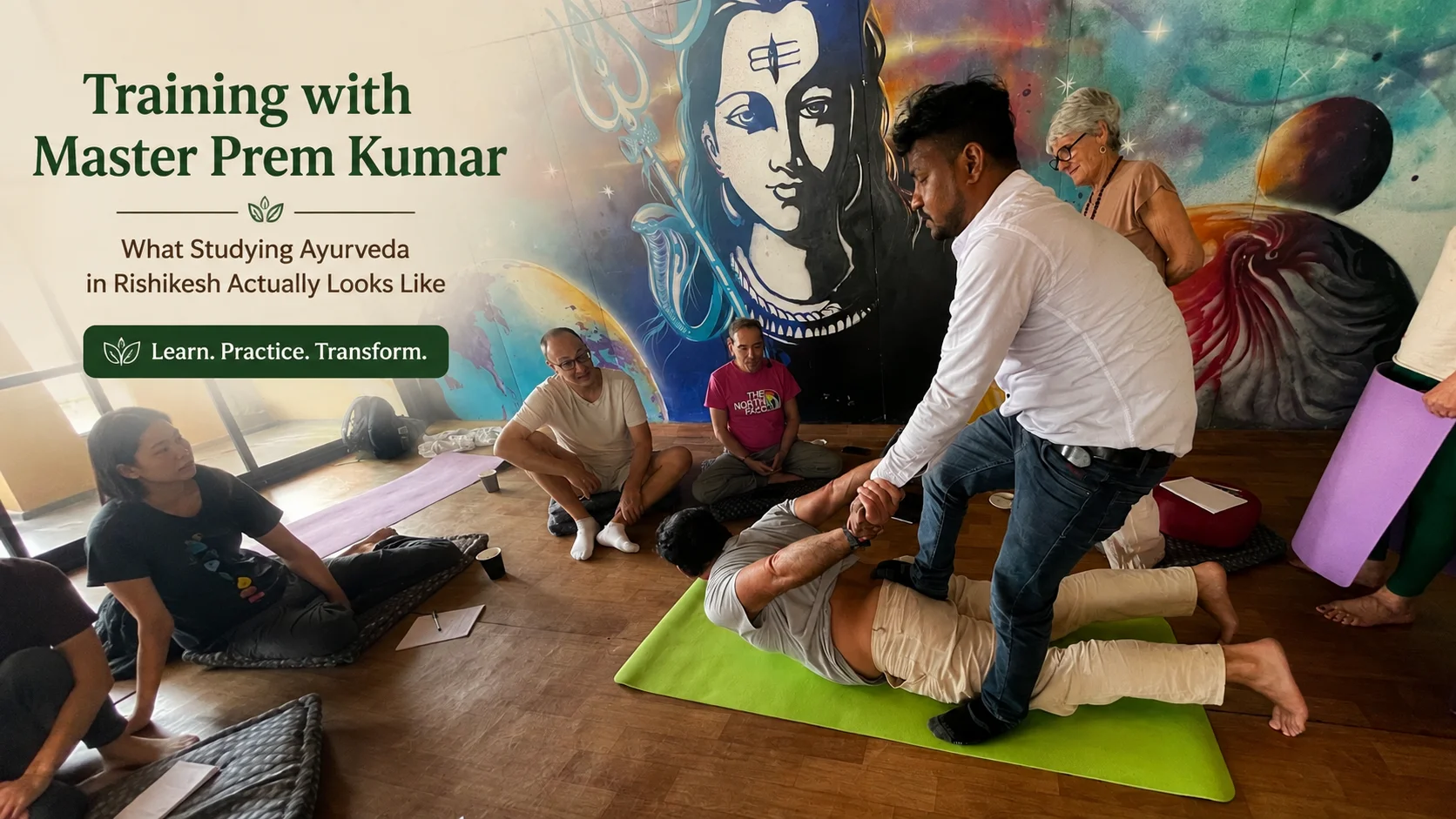
Days generally combine focused theoretical instruction — dosha assessment, oil selection, anatomical and energetic understanding depending on the course — with substantial hands-on practical time, working directly under supervision rather than simply observing demonstrations from a distance. Students receive real-time correction on pressure, technique, and positioning, the kind of specific feedback that's genuinely difficult to develop through self-study or video tutorials alone.
Group sizes are kept small enough that individual correction is actually possible throughout the day, rather than students working largely unsupervised while an instructor circulates briefly. This matters particularly for anything requiring precision — Marma point work especially depends on this kind of close, hands-on guidance, since incorrect technique on specific points can be ineffective or genuinely uncomfortable without careful correction.
Why Students Choose to Train Here Specifically
Students arrive from a genuinely wide range of backgrounds — practicing massage therapists looking to add Ayurvedic technique to their existing skill set, yoga teachers wanting to deepen their understanding of bodywork, complete career-changers drawn to Ayurveda as a new path entirely, and international wellness professionals seeking training with real depth rather than a quick certificate. What tends to bring people specifically to Rishikesh, and specifically to a smaller, practitioner-led program rather than a large institutional school, is the desire for genuine mentorship — training where the person teaching you is also the person who built the practice you're learning within, not a rotating faculty delivering a standardized syllabus.
From Single Treatments to Full Certification
Training programs range from focused, shorter courses — like the Single Marma Course for those adding one specific specialization — to comprehensive programs like the Ayurveda Marma Combined Course, which pairs massage fundamentals with marma specialization together, up to the full 30-day Panchakarma Certification for those seeking complete clinical training in Ayurveda's most intensive therapeutic system. For those wanting a general foundation in Ayurvedic massage technique specifically, the massage training courses, ranging from 3 to 14 days depending on depth needed, offer a structured path suited to different starting points and time availability.
The Difference Between Attending Training and Actually Learning
A recurring theme in how training here is structured: certification isn't treated as something earned simply by showing up for the scheduled days. Programs include genuine practical evaluation before certification is granted — confirming a student can actually perform the technique competently and safely, not just that they were present in the room. This matters because a certificate that doesn't reflect real, verified competence isn't especially useful to a student once they're back home trying to build a practice or add a new skill to an existing one.
What Happens After Training Ends
Training is understood as a foundation, not a finish line. Most practitioners describe an ongoing refinement of technique that continues for years after initial certification, built through actual practice and experience. What proper training under close, experienced guidance provides is a genuinely safe, correct starting point — the specific corrections and real-time feedback during the learning phase that are far harder to develop through self-study, and that shape how confidently and safely a practitioner works for years afterward.
If You're Still Deciding
If you're weighing whether to train here specifically, the most useful next step is usually a direct conversation before booking — describing your current experience level, what you're hoping to learn, and how much time you realistically have available. This helps identify which specific program actually fits, rather than guessing from a course list alone. Reach out via WhatsApp to discuss which training path makes sense for where you're starting from.
FAQ
Do I need prior experience to train with Master Prem Kumar? No, programs are structured to accommodate complete beginners as well as those with prior massage or bodywork experience, with pacing and depth adjusted accordingly.
How is training here different from a larger Ayurveda school? Training happens in smaller groups with direct, hands-on instruction from Master Prem Kumar himself, allowing for closer individual correction than is typically possible in larger institutional programs with rotating faculty.
Is certification here recognized professionally? Programs include genuine practical evaluation confirming real competence before certification is granted, which carries more practical value than attendance-based certificates regardless of the specific institution's name recognition.
Can I combine a specialization course with general massage training? Yes, courses like the Ayurveda Marma Combined Course are specifically structured to pair massage fundamentals with specialized training together in one program.
How do I know which course length or program is right for me? Reaching out directly before booking to discuss your current experience, goals, and available time is the most reliable way to find the right fit, rather than choosing based on course length alone.